

The science of Ping
November 13, 2026
At nearly every PGA Show I attended in the last decade, I interviewed Erik Henrikson of Ping about the Arizona company’s newest golf club offerings.
These chats are among the highlights of my week. This year was no exception. The Ph.D. engineer knows his stuff, and more importantly can explain the why of something at least as well as the what.
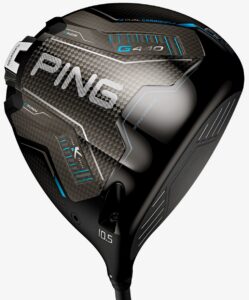
G440K
This year we had a longer discussion about his role in Ping’s club development process.
“I’m involved with all clubs. My team and I do fundamental research on how to make something sound good, or on the putters checking eye cues. We do research to understand how people behave, what’s the effect of center of mass on performance, what’s optimal. We do a lot of the upfront research to feed into our design team for each of these products, so they understand what they’re designing for,” Henrikson said.
His first example was the G440K driver. “This is the most forgiving, highest MOI-adjustable weight driver we’ve ever made,” he said. “We’re trying to remove as much mass from the center of the clubhead as possible and move it to the outside. This backweight has moved from 28 grams to 32 grams, a handload of weight to have deep and low in the head. The carbon fly wrap saved us those grams,” Henrikson said.
Other design changes addressed both mishits and noise. “We made some small changes to the geometry of the face, to help increase ball speed especially on off center hits – local thickness changes in the face. We also had to do some engineering on the inside with some geometry to make it sound good. Any time you make something this big, you want to make sure you don’t have a displeasing sound at impact. There are ribs inside and a carbon fiber rib that rides across the top of this crown. It stiffens it up. Creates a good sound.”
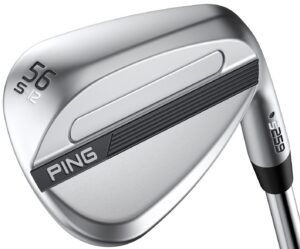
S259 wedge
Henrikson’s explained the noise issue and customer expectations. “If it sounds bad that can have an adverse effect on your performance. I can give you two drivers that on a robot are identical. But if one sounds bad, as a human you start reacting to that. I guarantee you’re going to get higher ball speed and performance from the one that sounds better, because you’re starting to react to what you hear in an adverse way. It’s super important that we deal with that. That’s a challenge,” he said.
The discussion about human factors included Ping’s new S259 wedges. The line includes six different sole grinds and 25 different grind/loft options.
“We removed a little half-groove [at the bottom of the club] based on some feedback from the tour. What was really interesting about it is the perception around it. The half-groove created the illusion of the leading edge being really rounded. We removed it to provide a little straighter looking lead edge,” he said. This change made it easier to square the club at setup.
Changes in wedge grip design should also help. “Vertical lines help you reference the grip when opening [the club face], making it repeatable on how much you open or weaken the grip. We also have angular rings that help you find a reference when you’re gripping down for distance. We also have these 3 lines that help with how much shaft lean you want when you set up,” Henrikson said.
Ping also dealt with the noise issue for the new i540 irons. “There’s a challenge with all the irons you have in the players distance category,” he said. “You have a really hot face, you’re trying to create a lot of distance, but with the geometry of these irons you have some acoustics issues. We created this inflated insert that is part of the cavity. It helps attenuate those unwanted frequencies without hindering face flexing and the ball speed we get out of the face.”
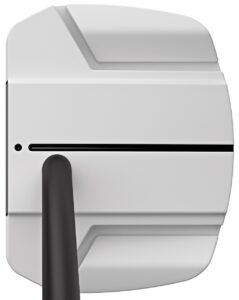
Scottsdale TEC putter
The new putter lines gave Henrikson the opportunity to discuss vision and aiming challenges.
“The Scottsdale TEC, which stands for Tour Elevated Concepts, have machined aluminum on top, 303 Stainless Steel on the bottom,” he said. “The PBAX insert helps us remove weight from the center, move it to the perimeter, [and] provide a soft touch feel.”
“A really striking part of this design is this small dot,” Henrikson said. “It has a big influence on one’s gaze pattern [during] set up. In all sports there’s this idea called quiet eye, where when someone sets up to shoot a free throw, archers set up before they pull the string for their target, elite athletes have this tendency to narrow their gaze. Their eyes don’t bounce around and that is directly connected to how quiet the mind is.”
“We found in our research that this little dot/feature helps tether their gaze. That directly leads, in every on-course test we’ve done, more putts are made. There’s this nice heat map that shows when this is on there, really focusing in on that leading edge, leading to a quieter mind before executing the putt. There’s a little bit of neuroscience for you,” he grinned.
South Team wins Delaware Cup
Over two dozen Delaware club pros competed in the 3d annual Delaware Cup competition at DuPont CC Nov. 2-3.
This year the South team won for the first time, with many Cape Region pros on the winning side.
The event raised $12,000 for the PGA REACH program, a charity-based operation of the PGA.
The 14 members of the South team (left to right) are shown here: Ian Madinger, Andy Hewitt, Greyson Rossi, Will Scarborough, Brooks Massey, George Bushby, Jake Shockley, Eric Willey, Mike Rushin, Chris Gray, Neil Maurer, Brian Rashley, Chris Krueger, and Jesse Williams.